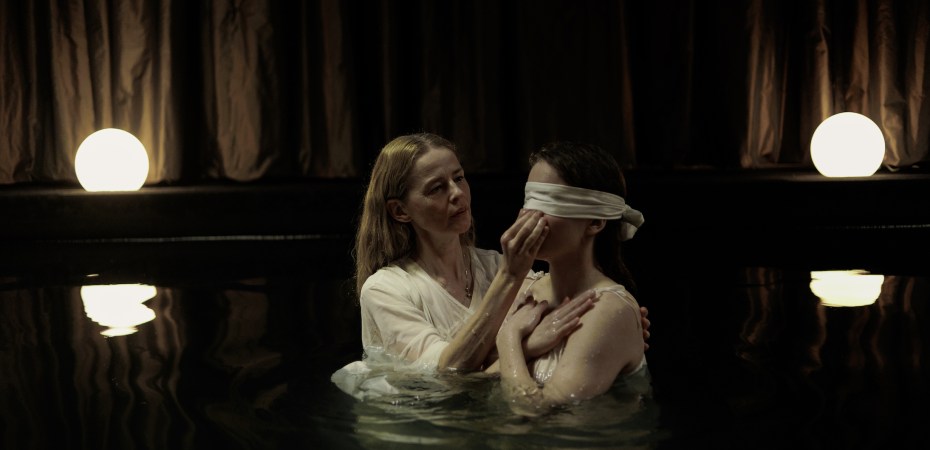
“Use your words. I can’t read your mind.” Those condescending words come from the most manipulative character in Icelandic horror film Natatorium, but it’s still good advice. The film focuses on the frustrated, conflicted silence in which family trauma and dysfunction thrive, so it makes sense for the communication between the characters to leave something to be desired. However, the script leans too heavily on this phenomenon, resulting in contradictory characterizations, nonsensical plot conveniences, and ultimately a film that grows more frustrating as its runtime stretches on. Natatorium is writer-director Helena Stefánsdóttir’s first narrative feature, and it is an uneven but promising debut. Her eye for blocking is impressive, and her ability to set and maintain tone makes me eager to see what she can do with a stronger script. But her abilities as a director can’t save the film from its undercooked story.
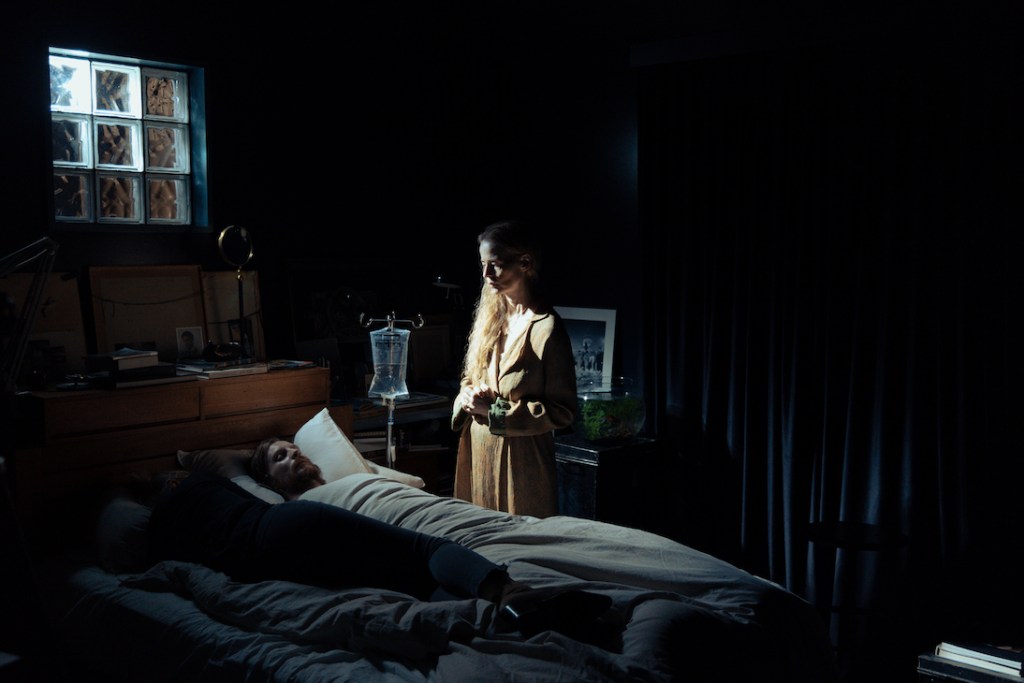
While her father is abroad on business, teenage Lilja (Ilmur María Arnarsdóttir) comes to stay with her grandparents so she can go to a big performing arts audition. (The actors playing characters across three generations look distractingly close in age; you may be tempted, as I was, to Google their birthdates once the credits start rolling.) Áróra (Elin Petersdóttir) and Grímur (Valur Freyr Einarsson) have a large, beautiful house with an indoor swimming pool, and Lilja is excited to stay there despite her father’s unexplained insistence that she not see her grandparents. Lilja’s uncle Kalli (Jónas Alfreð Birkisson) lives there as well. He remains in bed most of the time, with “weak lungs” given as the only explanation for his mystery ailment(s). When they find out Lilja is staying there, her aunt Vala (Stefanía Berndsen) and her father Magnús (Arnar Dan Kristjánsson) come to the house as soon as they can to try to talk Lilja into leaving, but they still refuse to tell Lilja (and, by extension, the audience) why she needs to leave. Rounding out the cast of characters — and injecting some much-needed but underused outside perspective — are Írena (Kristín Pétursdóttir), Magnús’s pregnant (and likely temporary) girlfriend, and Lilja’s boyfriend Davíð (Stormur Jón Kormákur Baltasarsson).
Lilja is named after her late aunt. As she tells Vala, Magnús told her that her namesake drowned as a child, but he didn’t tell her anything else. This is a recurring issue with the family, especially when it comes to Lilja. Information is carefully, frustratingly meted out, with vital family history arbitrarily deemed not worth mentioning. In a more assured, more cohesive script, this maddening behavior could make sense: fear, shame, and other ingrained behaviors from a life of dysfunction and abuse often cause people to stay silent when it would be far healthier to do the opposite. But even from that perspective, very little the characters do in Natatorium makes much sense. Magnús and Vala frequently talk about how stubborn Lilja is and how nothing they say would make any difference, but we never actually see any evidence of that. Granted, the two siblings have a skewed view of reality thanks to their upbringing (this is not a spoiler; though Natatorium is slow in revealing its secrets, such as they are, it is immediately clear that this is not a safe or healthy home). However, there is a disconnect between the film’s intention and its execution. There is a big difference between the behavior of a person who has been raised to see the world through the fractured prism of trauma and lies, and the behavior of a character whose refusal to verbalize their anxieties is the engine that keeps the plot from resolving too quickly.
Natatorium opens strong. A kaleidoscopic framing device draws the viewer into a distorted world of darkness and secrets, and a water motif becomes evident right away. Dripping and lapping sound effects play throughout the film, while slow dissolves and fluid camera movements evoke the sensory experience of floating in a swimming pool. We know right away that the titular pool is the most important (and the scariest) room in the house. Wordless scenes of the characters moving through the house immediately convey their character dynamics. A wide shot that allows the viewer to see both floors of the house simultaneously shows Áróra slowly guiding the mysteriously frail Kalli down the hallway upstairs while free-spirited interloper Lilja confidently (and obliviously) crosses the frame in the opposite direction on the bottom floor. The distant, ineffectual Grímur sits alone in his study while Áróra sneaks through a door nearby. Everyone in this film is always sneaking or evading; there is no direct communication, which is typical of such a fractured and dysfunctional family. To punctuate their disconnection, Stefánsdóttir frames Vala, Áróra, and Magnús in a striking tableau as they prepare for a dinner party to celebrate Lilja being accepted into the performance company after her audition. Vala and Magnús blow up balloons, with the sounds of their breathing amplified to an eerie degree, and stand in the kitchen on opposite sides of Áróra looking in different directions. Their bodies are closed off; both of them, especially Vala, adopt defensive positions. This single image tells you so much about how these characters feel about each other and relate to each other; it’s a perfect symbol for the lack of safety they feel in the house, their refusal to communicate, and their broken family bonds. It’s a shame that the dialogue can’t manage the same level of effective storytelling.
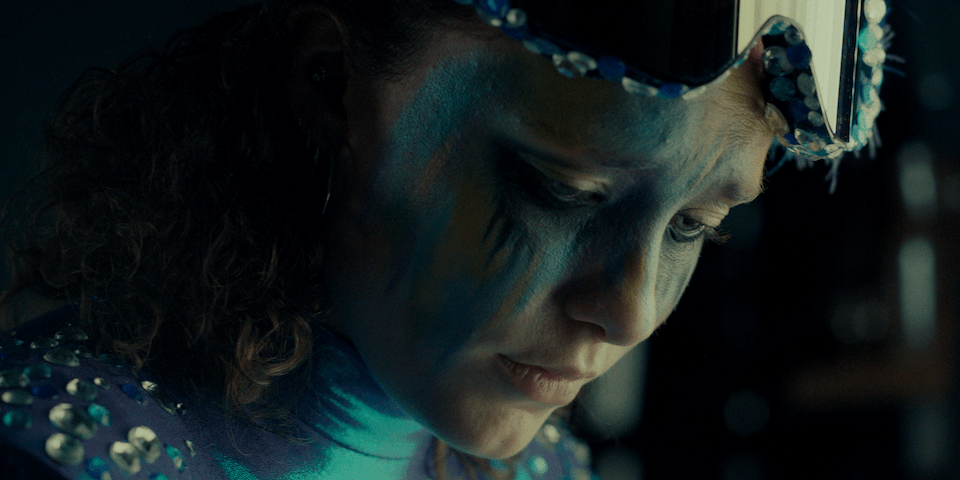
Thanks to Stefánsdóttir and cinematographer Kerttu Hakkarainen, Natatorium looks great, and its keen use of visual language is the reason I’ll be seated for Stefánsdóttir’s next film. The cast does the best they can with the confused script: Petersdóttir’s Áróra is full of icy menace and concealed power, while Berndsen beautifully portrays the conflicted push-and-pull of Vala’s wounded inner child. She’s constantly poised to flee the house, but she keeps getting drawn back in, sometimes trying to reason with her mother and sometimes trying (and failing) to fight back. That push-and-pull is an apt description for the movie itself: the thinly sketched characters pulled me out of the film, but its visual richness drew me back in. With a stronger script, Natatorium would be an outstanding horror debut, but its visual depths can’t quite compensate for its ultimate shallowness.
 We Who Walk Here