
“Choices, choices, choices.” Free will is the illusory mechanism driving the choose-your-own-adventure plot of Freddy Macdonald’s neo-noir gem Sew Torn. The confident, idiosyncratic tone of Macdonald’s debut feature — which he directed and edited, as well as co-wrote with his father Fred Macdonald — announces him as a talent to watch. Propulsive, tightly scripted, and hilariously offbeat, Sew Torn delves into the inescapable legacies that parents leave their children, asking the viewer to consider how much freedom we really have when the paths laid out before us all seem to lead to the same destination.
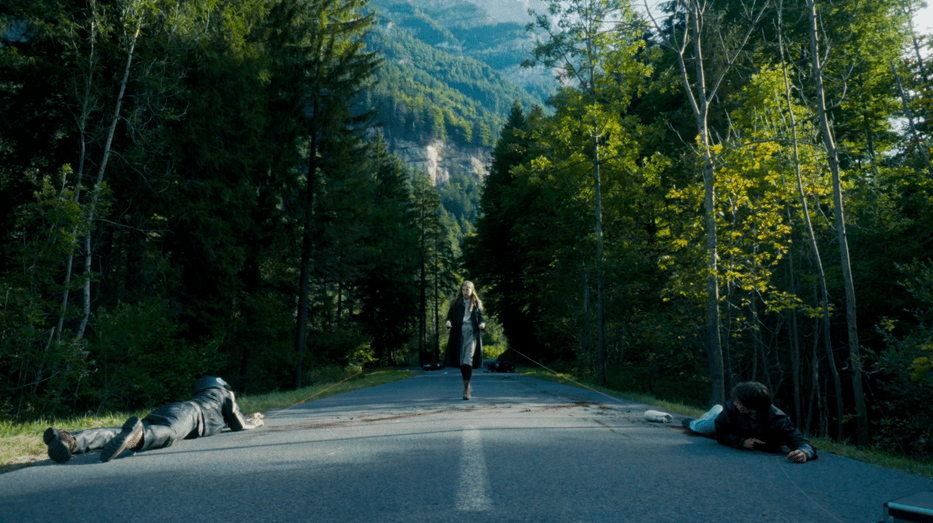
Barbara (Eve Connolly) is the “Mobile Seamstress” of a quaint Swiss hamlet. She traverses the town’s winding roads in a tiny car with a giant bobbin on the back as she hurries to a wedding dress fitting. While rushing back to her shop to fetch a replacement button, she runs across a chaotic scene: two injured men, two crashed motorcycles, two guns, and one obviously valuable briefcase lie in the middle of the road. The way she sees it, Barbara has three choices: “Perfect Crime,” “Call Police,” and “Drive Away,” which serve as chapter headings for the segments that follow. The rest of the film explores how each choice works out for Barbara as she tackles her escalating problems with bizarre yet compelling coping mechanisms inherited and adapted from her life of strange isolation.
Barbara is trapped by the threads of the past. She runs her late mother’s shop — “Duggen’s: Home of the Talking Portraits” — which features embroidered renditions of family photos with string-activated voice recordings. Those same portraits hang from the ceilings in Barbara’s home above the shop. In what is clearly a daily routine, she pulls different strings to hear greetings and encouraging messages from her mother as she gets out of bed and prepares for her day. These glimpses into what Barbara’s life was like as a child are bizarre and heartbreaking. Her mother obviously made these portraits for her before she died, and the ironic combination of her mother infantilizing her yet placing a heavy adult burden on her shoulders — in her deathbed recording, Barbara’s mother tells her, “One day, you’ll be me” — explains a lot about the odd way that Barbara navigates the world now that she’s on her own.
Barbara approaches each of her three choices by devising elaborate Rube Goldberg-esque contraptions out of thread. Macdonald wrings an impressive amount of both humor and suspense out of Barbara’s mechanisms. Watching her try to land a threaded blow dart through the tiny circular target of a keychain is impossibly tense, and it only gets funnier every time a character utters a befuddled “What the fuck?” as Barbara’s multicolored bobbins come into play during a showdown. Interestingly, the complicated mechanisms that Barbara devises often absolve her of having to make a direct choice. For example, she frequently uses her thread to position guns strategically, ensuring that she doesn’t actually give them to anyone or pull the trigger herself. Thread is how she interacts with the world, but it’s also how she keeps the world at a distance. In a film that is ostensibly all about choice, Barbara does whatever she can to avoid making one.
Connolly is fantastic at conveying Barbara’s internal conflict, particularly through her physical performance. She shows no hesitation as she deftly works out her thread contraptions on the fly, but she’s twitchy and unsure of herself when she doesn’t have a needle in her hand. The rest of the cast is just as compelling. The kooky small town features strong comedic turns from Caroline Goodall as high-strung bride Grace and K Callan as Ms. Engel, the town’s sole police officer, notary, and wedding officiant. The two motorcyclists Barbara finds on the road are Joshua (Calum Worthy), a young man whose story is surprisingly similar to her own, and Beck (Thomas Douglas), a professional criminal who just wants to get the hell out of town before Barbara gets them all killed. The man they all fear is Hudson (John Lynch), a terrifying mobster who also happens to be Joshua’s dad. Lynch’s presence is strong and steely; he has a quiet magnetism that is as frightening as it is fascinating, and the viewer understands right away why Beck and Joshua are so scared of him.
Hudson’s menace looms over the film long before we ever see him. In one of the smartest touches in the Macdonalds’ script, Barbara’s doting mother creates a funhouse mirror reflection of Joshua’s terrifying father. We hear her voice throughout the film, offering disconcertingly chipper advice, and we realize that her love and support is actually suffocation in disguise. Joshua’s father is a scary mobster and Barbara’s mother was a sweet seamstress, but at the end of the day they’re both parents who won’t allow their children to live their own lives. Much of the joy in a story structure like this lies in examining how its timelines fracture and how they converge. The brilliance of Sew Torn’s approach is the quietly devastating way those fracture lines curve back around to the same thematic conclusion. No matter how hard the characters try, they can’t escape becoming the people their parents want them to be. The pattern is already cut and laid out; all they can do is sew it together.
 We Who Walk Here