Slasher films have historically faced paradoxical criticism. They’re labeled immoral for supposedly reveling in gratuitous sex and violence, and they’re labeled moralistic for allegedly punishing female characters who drink, do drugs, and have sex. In a Violent Nature, writer-director Chris Nash’s feature debut and a fine addition to the venerable tradition of Canadian slasher cinema, explores an intriguing alternative to this binary: slasher killers are neither good nor evil; they are simply amoral elements of nature. By adopting a fascinating change in visual perspective, In a Violent Nature removes heroes and villains from the equation entirely, depicting slasher killers as territorial animals who attack only when provoked. It’s a hypnotic deconstruction of the slasher film that asks viewers to slow down and reckon with the subgenre itself, as well as their own relationship to it.
The set-up is familiar. A group of friends take a trip into the woods. They swim, they tell scary stories around the campfire, and they disturb their natural surroundings when one of them pockets a necklace he finds hanging from a tree. This act of interference awakens Johnny (Ry Barrett), the subject of the local legend recited around the campfire: the story of the White Pine Slaughter. The story itself seems to be all about good and evil — young Johnny is lured to his accidental death, his vengeful father is murdered, the men responsible all die mysteriously, and the powerful lumber company behind it all covers the whole thing up to protect their bottom line. Seventy years later, an undead Johnny exists outside of this good-evil dichotomy. He is just as much a part of the forest as the rocks and trees, only waking from his hibernation when unwitting trespassers take off with his mother’s necklace. Johnny — motivated not by hatred or revenge, but because this is simply what he does — cuts a bloody path through the forest to retrieve the necklace, keeping the White Pine legend alive and adding to his body count.
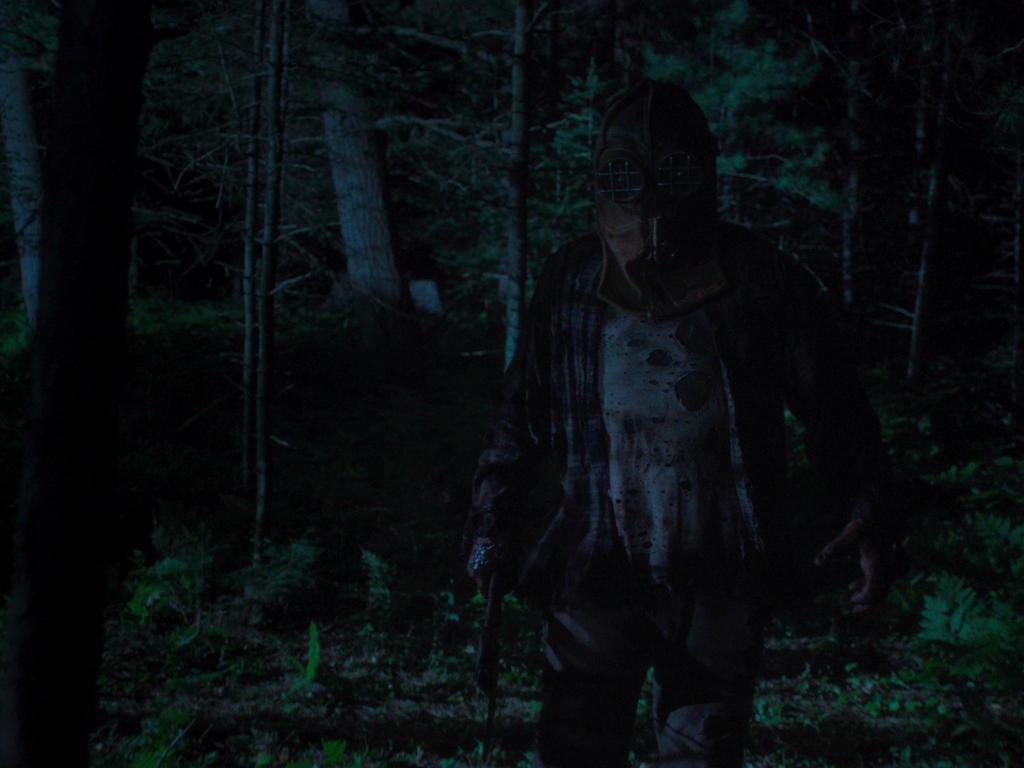
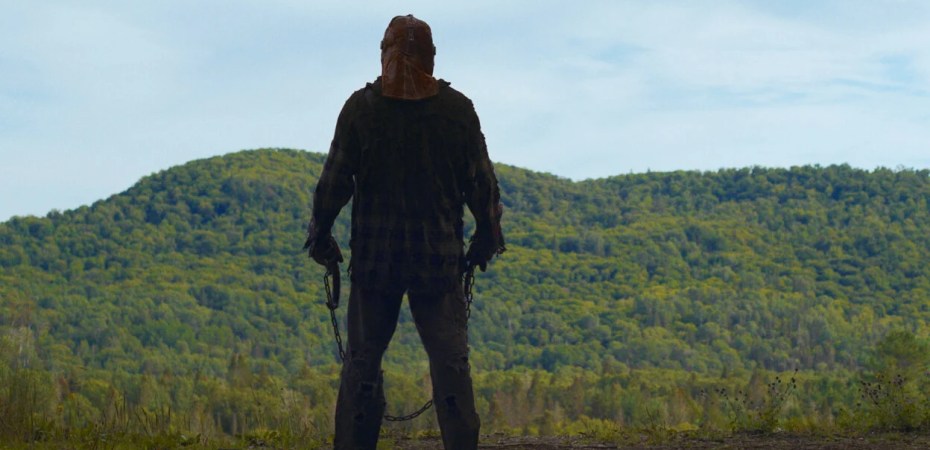
It can be tempting, particularly in times as Terminally Online as these, to review reactions to a film rather than the film itself. I try to avoid that as much as possible, but I’ve seen so many readings of this film that differ so fundamentally from my own that I feel compelled to address some of them. Chief among them is the idea that most of the film unfolds from Johnny’s perspective. Not so: In a Violent Nature clearly and deliberately avoids using killer POV. It’s perhaps the most interesting and striking aspect of the film. The movie (courtesy of cinematographer Pierce Derks) takes great pains to achieve a detached perspective; it would be more accurate to say that the viewer watches the events unfold from the POV of a squirrel in a tree or a bee flying through the woods. Long takes of wide static shots dominate the film, as if the viewer were a boulder weathering the slow and inevitable passage of time. We spend most of our time with Johnny, but we are observing him as well: the camera follows several paces behind him as he methodically moves through the forest, and we frequently spy him watching the campers as he calmly blends into the leaves or the shadows of the woods. It’s a hypnotic, meditative approach to slasher cinema (specifically ‘inhuman killer in the woods’ slasher cinema) that asks you to sit with each element of the subgenre and think about it rather than cheer at each outrageous kill and then wait impatiently for the next one.
Speaking of kills: reports of extreme audience reactions (screaming, fainting, vomiting, etc.) are a tried-and-true horror marketing tactic. I myself am hardly immune to the promise of an inventive, gory kill. However, the film’s death scenes — which are indeed impressively gory and inventive — are filmed in such a way that I interpret them as the deliberate antithesis of the “gnarly kill.” I’m puzzled by accounts of viewers cheering, laughing, or applauding scenes that all but look you in the eye and say, “Don’t react; observe.” The kills are presented in the same patient, detached manner as the rest of the film. Any gruesomeness or overkill seems designed to elicit thoughtful reflection, not cheering and high fives. (I mean that sincerely. Each time Johnny dispatched someone, I found myself pondering the mechanics of human anatomy, not grinning or pumping my fist.) The most grueling sequence for me (not, incidentally, the one that seems to be causing the most chatter amongst gorehounds) is also the calmest and quietest. It forces you to wait alongside the recipient of Johnny’s creative violence; it is not scary, but it is horrifying. Human bodies are impassively reduced to rivulets of fluids and piles of meat. Just as Johnny is simply a territorial animal doing what his nature demands, his “victims” are merely animals that strayed into the wrong part of the woods and paid the inevitable price.
Johnny rarely shows any emotion, and the few times when he does seem angry or vindictive may very well be the result of projection on the viewer’s part. He slashes methodically, unhurriedly. The only sounds are diegetic (with ingenious sound design from Michelle Hwu and Tim Atkins). If other people are close enough that we the observers can hear their conversations, jokes and snippets of chitchat fade in and out, or we hear their whispered warnings to each other once they realize how dangerous these woods are. Beyond that, we only hear the sounds of the forest: chirping birds, rustling leaves, Johnny’s plodding footsteps, and occasionally Johnny’s weapons entering the campers’ bodies.
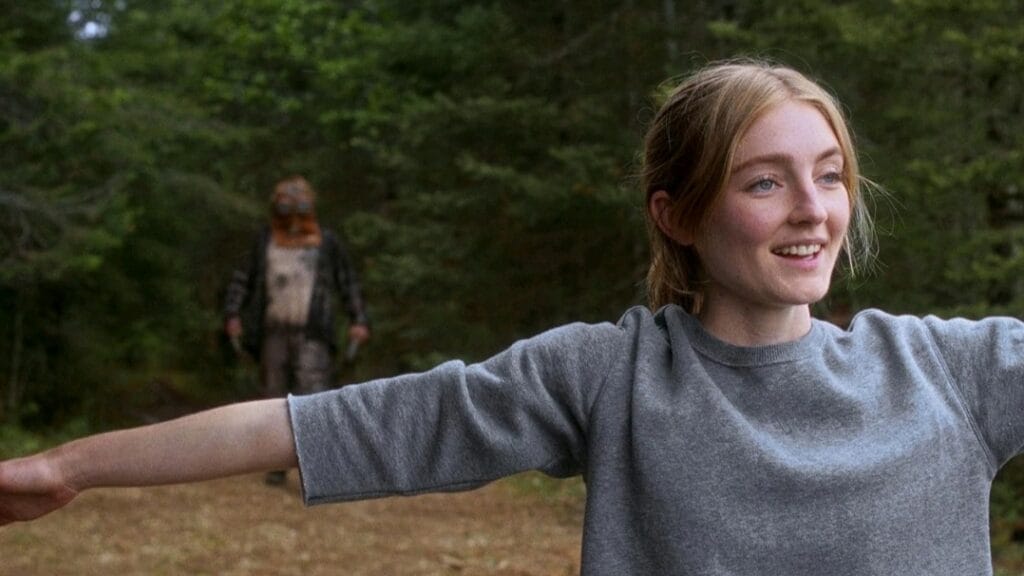
Just as the death scenes seem designed to be the antithesis of the gnarly kill, the film as a whole seems designed to be the antithesis of suspense — with one notable exception. (The rest of this paragraph may be quite spoilery, so consider yourself hereby warned. Skip to the beginning of the next paragraph and you’ll be safe.) At one point, a camper escapes to the road and flags down a truck for help. Nash employs multiple misdirects drawn from slasher and horror history to make us question how safe this supposed rescue truly is. A suspicious item hangs from the truck’s rear view mirror. The passenger side window dominates the frame in an extended take, priming us to wait for Johnny to come crashing through the glass to claim the girl who got away. A shot of the woods where Johnny’s masked face could be lurking is juxtaposed against a close-up of the survivor’s frightened face. The close-up is especially jarring because we see so much of the film unfold from a distance. The tight shot doesn’t force identification with the survivor, though; rather, it underscores the lack of traditional terror in the film. That brief, icy jolt of adrenaline reminds you of what you’re used to feeling when you watch a slasher movie, and it invites you to consider what it means when you don’t feel it.
In a Violent Nature is not a straightforward slasher flick. Viewers who want a gory take on a familiar formula won’t find what they’re looking for here (and if they do, I would humbly suggest that they give the movie another crack). Nash clearly knows and loves traditional slashers, but he just as clearly has something a little different on his mind. What does it mean for the horror genre — and for horror fans — when you put some distance between yourself and this medium that you love; when you have nothing and no one to cheer for; when all there is in the world is unfeeling brutality and the random chance of entering a place you will never leave? Pitiless and patient, In a Violent Nature is a fascinating formal deconstruction of the slasher film that pulls out the subgenre’s insides and asks the viewer to examine what really lies beneath its skin.
 We Who Walk Here